January's Recipe:
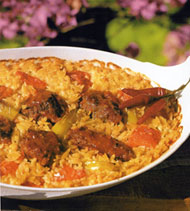
Baked orzo with vegetables
(Youvetsi Me Lakhanika)
|
|
Ingredients: |
- 1
generous cup / 250ml Greek
extra virgin olive oil |
|
- 1 large onion, finely
shopped |
- 3 tomatoes, skinned and
finely
diced |
|
- 1
stick celery, finely sliced |
|
- 2
cloves of garlic, finely sliced |
- 1 red bell pepper,
seeded and
finely chopped |
|
- 4
cups / 500g kritharaki |
|
- 8 - 12 keftedakia |
- 1 3/4 cups / 200g
crumbled
sheep's milk cheese |
|
- Salt |
|
- Freshly ground pepper |
Pre heat the oven to 350F (180C). Heat the
olive oil in a pan and fry the onions and garlic
until softened. Add the tomatoes, celery, and
bell pepper, then season with salt and pepper.
Reduce the heat and cook the vegetables for 5
minutes. Remove from the heat and stir in the
orzo. Half fill a high-sided flameproof dish
with the vegetable and noodle mixture, top up with
hot water, and stir. Bake in a preheated oven
for about 1 hour. Shortly before the end of
the cooking time, top with the keftedes and the
crumbled sheep's milk cheese and leave in the oven
for a few minutes to brown. Serve straight
from the dish while still hot. |
|
|
Excerpts from:
"Culinaria
Greece"
by Marianthi Minola
Are you missing some pices and incredients for your
recipe?
|
|
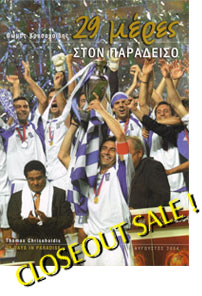
29 days in Paradise
Euro 2004 Picture Book by Chrysohoidis - Close Out Sale
This is a photo album that
takes you through the 29 days to the European
Championship in 2004. Focusing in our National team,
each page is a historic moment to victory. Written by
Thomas Chrisohoidis.
Hardcover in Greek.
This is a closeout sale at the amazing price of
$89.95 (regular $120). Limited number of books
available.
Get your copy today!
Note: The book's shipping weight is over 4 lbs (2 kgs).
|
|
|
Watch Your Manners In Greece |
|
Communication |
|
Continued from
December's Issue...
- Organizing breakfast meetings is not customary in
Greece. We usually have breakfast with friends when
staying in a hotel or when we are guests at
somebody's house.
-
Coffee has well nigh replaced a nutritious breakfast
in our country.
- Iced coffee is very popular in Greece, and some
consider frappe (cold, frothed Nescafe) as one of
the greatest Greek inventions after Euclid's
elements! A gentleman should never drink this coffee
(or any other drink) with a straw, since this spoils
his facial expressions.
- The
traditional Greek cafeteria ("kafeneion") has been
replaced by French or Italian style cafes. Etiquette
manners apply at all such establishments, whether
traditionally Greek or European-influenced.
- When
people go to cafes they don't just drink their
coffee and leave. Sitting at a cafe is one of
Greek's best hobbies. Contrary to the norm in many
other countries, no waiter will stand in front of
you asking you to pay the bill and implying you must
leave as soon as you have sipped your last drop of
coffee. You may lazily sit there all day and no one
will disturb you unless of course you have fallen
asleep and the cafe is closing.
- Inviting someone for tea is not common in Greece.
On the rare occasions when an invitation is made for
tea, it is usually an evening event, and is more
commonly attended by women than men.
-
Dinner invitations are usually for between 9 and 10
o'clock at night.
-
Greeks are not known for their punctuality. If,
however, an invitation is for 9 o'clock, we should
arrive no later than a quarter of an hour after the
appointed time, especially if it is a seated dinner.
Pre-cocktail drinks have been especially invented
for this reason. If we are going to be more than
half an hour late we should call and inform our
hosts. (You should follow etiquette and try to be on
time; but do not be surprised if everyone else is
late).
- In
Greece we have kept the American custom of always
offering our hostess a gift. This is necessary when
invited for dinner at somebody's house. It is rather
unrefined to arrive at a reception with flowers or a
present. It is advisable to send our gift either the
day before or the day after the dinner party.
- At
an informal dinner party it is always a sign of
politeness to offer to help our host or hostess with
the dishes and cleaning up of the table. We
shouldn't insist if our hostess refuses. What's
important is to at least offer to help.
-
There are two ways of seating our guests in Greece;
one is according to protocol, the other is according
to their personality.
- The
seat of honor is on the hostess' right. The
honorable guest is usually the eldest person or the
person with the highest title. The next most
honorable guest sits on the hostess' left. According
to English formalities the most honorable guests sit
at the head of the table, whereas in France they sit
in the middle. At a friend's dinner party however,
where all guests are of a similar age, the guest of
honor is the newest comer.
- If
it is a family meal, the two mothers-in-law sit on
the left and right hand side of the host and the
fathers-in-law accordingly on the right and left of
the hostess. Father in law number 1 sits opposite
mother in law number 2 and father in law number 2
sits opposite mother in law number 1. Couples sit
opposite each other. If the atmosphere is relaxed,
we may sit wherever we wish.
- A
widow keeps her husband's seat, married women have
priority over divorced women, and unmarried ones
come last.
- If
we don't like our prearranged seat, we shouldn't
swap places at our own will. We should let our host
know as soon as we see him. Years ago, if someone
was displeased with his seating arrangement, instead
of leaving the table and showing offence, he or she
crossed the knife and fork over the plate and
refused to be served.
- In
Ancient Greece, when the future king of Sparta,
Agisilaus, was seated in a non-honorary place, he
commented that, "It is not the seats that honor men,
but the men who honor their seats."
- Men
must wait for women to be seated first.
- We
should wait for our hostess to sit before we take
our places. We should also wait until she commences
eating before we do.
- It
is customary in Greece, when dining at a restaurant
or taverna, for men to pay the bill. However, many
women nowadays in Greece offer to pay the bill, or
at least to contribute their share.
- If a
lady has invited a gentleman, however, it is useless
for him to make any move towards paying the bill.
Excerpt from "Watch Your Manners In Greece" by
Christos K. Zampounis
|
|
|
|
Special Feature: With Music and Dance
 The
word "music" comes from Greek, and
originally applied not only to music in the
narrow sense but also meant all the musical
arts, and therefore included dance, which is
one of the oldest forms of human expression.
Young men dance in Homer's Odyssey; Sirens
sing, or at any rate emit sounds; Pan plays
his pipes and Athena, briefly, the double
flute; Apollo plucks the lyre - no wonder
songs and dances with traditional
connections still have a firm foothold in
Greek daily life. Even in the cities
it is not unusual to see young people
dancing step sequences, parts of which may
be hundreds of years old, and Greek children
still learn some of their country's
best-known folk dances at school. The
word "music" comes from Greek, and
originally applied not only to music in the
narrow sense but also meant all the musical
arts, and therefore included dance, which is
one of the oldest forms of human expression.
Young men dance in Homer's Odyssey; Sirens
sing, or at any rate emit sounds; Pan plays
his pipes and Athena, briefly, the double
flute; Apollo plucks the lyre - no wonder
songs and dances with traditional
connections still have a firm foothold in
Greek daily life. Even in the cities
it is not unusual to see young people
dancing step sequences, parts of which may
be hundreds of years old, and Greek children
still learn some of their country's
best-known folk dances at school.
When people talk about Greek music
today, they usually mean songs written in
the 19th century, which have a historical or
political significance. Many of them
were protest or resistance songs, with which
people could identify.
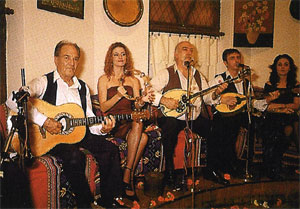
The most important Greek musical genre
of the last century is the rembetiko,
which originated in the poor quarters of
Athens at the time when the first Greek
refugees from Asia Minor, who had lost
everything they owned, settled there around
1923. With no money, no jobs, and
pushed to the margins of society, they met
in the evenings in the simplest restaurants
to give musical expression to their
melancholy. Today people compare the
rembetiko to the American
blues, which arose in similar circumstances.
This kind of music, which has become
socially acceptable since the 1950s, has
hardly changed, although the conditions in
which it is performed have. What was
once the lament of the homeless has now
become entertainment for relaxing evenings,
when there is not only singing and dancing
but also a great deal of eating.
 |
 |
 |
 |
|
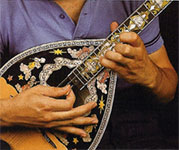
The
bouzouki is considered the most
Greek of all musical instruments.
No music bar can be without it. |
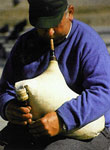
Gaida,
the Greek bagpipe,
is one of the instruments used for
folk music. |
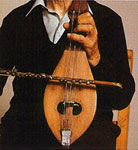
Modeled on the ancient lyra, this
three-stringed instrument is played
like a violin. |
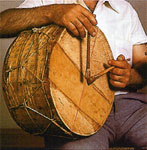
Tambouri,
the classical drum,
is beaten hard and makes a muffled
sound. |
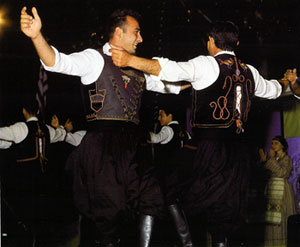 Among
round dances of rural origin, two basic
groups can be distinguished according to
their tempo and types of steps.
Sirtos are slow round dances with
sliding, shuffling steps. Pidiktos
are faster; the dancers hop, skip, stamp,
and jump. Round dances are always
danced in a counter-clockwise direction. Among
round dances of rural origin, two basic
groups can be distinguished according to
their tempo and types of steps.
Sirtos are slow round dances with
sliding, shuffling steps. Pidiktos
are faster; the dancers hop, skip, stamp,
and jump. Round dances are always
danced in a counter-clockwise direction.
Among the five best-known of the 150
Greek dances are two centuries-old peasant
dances, kalamatianos and tsamikos,
and three dances, seibekikos,
khasapikos and tsifteteli,
belonging to 20th-century urban popular
culture.
Kalamatianos: this dance, which
comes from Kalamata in the
Peloponnese, is danced by a number of
people holding hands in a line. The
leader dances variations on the basic
long-short-short step.
Tsamikos: this dance from Epirus
is also known as the "handkerchief" dance,
because the leader and the second dancer
hold opposite corners of a handkerchief.
This round dance in three-four time is
danced mainly by men. At the
time of the war of independence, it was
thought of as the dance of the mountain
fighters. At the climax of the
tsamikos, the leader executes
complicated, truly acrobatic leaps.
Seibekikos: this was
originally a dance for men, but is now also
danced by women. This
improvisatory dance is led by one person, or
by people who circle round one another.
In the world-famous film Zobra
the Greek, Anthony Quinn danced
something resembling a seibekikos.
This dance is considered difficult, because
it has no set sequences of movements.
It relies entirely on the dancer's
individual interpretation.
Khasapikos: in this
"butcher's dance," men and women hold each
other by the shoulders with outstretched
arms. The basic pattern of the step
sequence is three side-steps to the right,
three to the left and two cross-steps
forward. The movements of
khasapikos are slow and dignified.
The origin of this dance is uncertain, but
people have tried to find a connection with
the Byzantine makellariokos (makellaris
as in butcher). The sirtaki is
actually a simplified version of the
khasapikos and was specially created to
the music of Mikis Theodorakis for Anthony
Quinn in the role of Zorba. Nobody
could have foreseen at the time that this
compromise solution would become the most
famous of Greek dances. Where the
khasapikos is tense and concentrated,
the sirtaki is relaxed, but lively,
and speeds up toward the end.
Tsifteteli: this dance
of Turkish origin, with its circling,
markedly sensual movements, used to be the
all-female equivalent of the khasapikos.
It is another dance that is no longer danced
separately by the two sexes.
and more... |
|
|
What's
New!!! |
|
CDs & DVDs |

Nikos Vertis PES TO MOU XANA cd single |

Kalomira Pezis?
|

Giorgios Giannias Proto Thema
|

Giorgos Tsalikis Piretos |

Eleftheria Arvanitaki, Dromoi Parallili (2 CD)
|

Stratos Dionisiou AKOU VRE FILE LIVE(2CD) |

Adrianna Babali, Min Pis Pote |

Marinella Tipota Gen Ginete Tihea |

Dimitris Mitropasnos Pes Mou T'alithina Sou |

Stamatis Gonidis 2 CD & bonus DVD (PAL) |

Elena Paparizou Mambo |

Natalia, Ise H Mousiki Mou |

Dimitra Galani & Alkisti Protopsalti, Zontana Sto Vox
|

Peggy Zina |

Pashalis Terzis |

Notis Sfakianakis Ana...gennisis |

Notis Sfakianakis, Ana Gennisis Collector's Edition +
DVD (PAL)
|

Nikos Vertis, POS PERNO TA VRADIA MONOS + bous DVD (PAL) |

Despina Vandi, SPECIAL EDITION & 4 new songs (PAL) |

Maria Nomikou, IME H MARIA SOU |

Lefteris Pantazis, ALLI MIA NIHTA (2CD) + bonus DVD
(PAL) |

Nikos Kourkoulis, TA KALITERA (2CD) |

Anna Vissi, Nylon (Dual Disc) CD & DVD |

Elli Kokkinou SEX |

Sakis Rouvas The Ultimate Collection 1991-1996 CD w/
Bonus DVD |

Antonis Remos San Anemos CD
|

Antonis Remos, San Anemos (Dual Disc) CD & DVD |

Antzela Dimitriou Ta Kalitera 32 best of... (2CD)
|

Pitsa Papadopoulou
|

Zafiris Melas Balantes Ke Zeibekika |

Haris Alexiou Paraxeno Fos |

HRISES EPITIHIES 2006 (2CD) 30 super hits |

HRISO PAKETO 2006
|

Minos 2006 (2CD) Super Hits |

KOLASI 2006 + bonus DVD (PAL) |

HEAVEN 2006...H SILLOGI |

TA DIKA MAS LAIKA classic and new |

KAFE ME TIN ELENI + bonus DVD (PAL) |

Greek Mix 2005 (2CD) 46 dance hits |

GREEK LOUNGE 2 songs from Greece & around world |

TA TRAGOUDIA TOU STRATOU LIVE (2CD) + bonus DVD (PAL) |

Stamatis Kokotas Oi Megaliteres Epithies Tou...
|

Yiannis Kalatzis Oi Megaliteres Epitihies tou... |

Haris Alexiou Oi Megaliteres Epitihes Tis - Best of
Alexiou |

The Best of M. Theodorakis |

Dimitra Doumeni Make a Wish Christmas Holiday classics
|

Hey Yia Yia CD
|

Antenna 1 - Min mou les Antio complete season 8-DVD set
(NTSC) |

Eurobasket
Belgrade 2005 7 DVD set (PAL) |

Neraida Ke To Palikari - NTSC zone 1
|
|
|
Books |
|
|
|
Audio Books in Greek |
|
|
|
Children's Books in Greek or in English & DVDs |
|
|
|
Gold
Jewelry |
|
|
|
Costume Jewelry |
|
|
|
Evil
Eye Jewelry |
|
|
|
Accessories |
|
|
|
Latest additions to the Torino 2006 Pin Collections
(Limited Edition) |
|
|
|
Food |
|
|
|
Greek
Christmas Ornaments still available |
|
|
|
Featured Destination:
Kythnos |
|
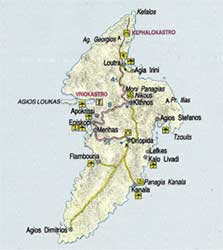 GEOGRAPHY.
This island, the second of the Western Cyclades, lies
between Kea, Syros and Seriphos. It is 99 sq. km. in
area, has 98 km. of coast, 1,502 inhabitants and is 52
nautical miles from Piraeus. Its capital is Kythnos (Chora)
or Mesaria. A ferry boat operates between Kythnos and
Lavrion, via Kea, as well as Piraeus (more frequent
during the summer). GEOGRAPHY.
This island, the second of the Western Cyclades, lies
between Kea, Syros and Seriphos. It is 99 sq. km. in
area, has 98 km. of coast, 1,502 inhabitants and is 52
nautical miles from Piraeus. Its capital is Kythnos (Chora)
or Mesaria. A ferry boat operates between Kythnos and
Lavrion, via Kea, as well as Piraeus (more frequent
during the summer).
The terrain is mountainous
(highest peak Profitis Ilias, 368 m. a.s.l.) with small
areas of flat land and many coves. The population is
engaged exclusively in agriculture and animal husbandry.
The island is particularly well-known for its
therapeutic springs (Loutra), on account of which it was
known as Thermia. With very few tourists and lovely
beaches, Kythnos is an ideal spot for those seeking
solitude and island life with minimal comforts.
HISTORY. In antiquity the island was known by
several names and has been inhabited since Neolithic
times, as evident from recent finds from Loutra, dated
7000 - 6500 BC, the earliest proof of human presence in
the Cyclades. In Mycenaean times Dryopes lived here and
it was they who gave the island its present name.
Kythnos played an active role during the Persian Wars,
joined the Athenian League, was subject to the
Macedonians, Ptolemies and Romans and in Byzantine times
belonged to the Thema of the Aegean. During the Latin
occupation it was part of the Duchy of Naxos. In 1337 it
was ruled by the Italian Gozzadini family who maintained
their preeminence even after the island was pillaged by
Barbarossa (1537), up until 1617 when they were ousted
by the Turks. During the reign of king Otto it was a
place of exile for revolutionaries and political
opponents.
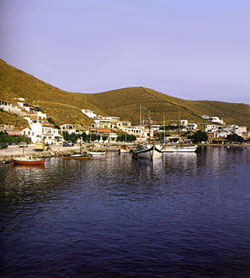
SIGHTS-MONUMENTS. The island's capital, Chora, stands on a hill in
the hinterland and is not visible from the sea. The
typically asymmetrical Cycladic houses spread out to
right and left of the two parallel main streets. On a
nearby spur stands the monastery of the Virgin of Nikos.
There are several Postbyzantine churches in Chora (the
oldest is the Holy Trinity), built according to Western
prototypes since the Catholic faith held sway here for
quite some time. The majority have wood carved
iconostases (Saviour, Taxiarchs, Christ, St. Savvas,
Transfiguration) with important icons in the
Veneto-Cretan style, painted by the hagiographer
Skordilis.
North of Chora (approx.
1.5 km.) are the remains of a Hellenistic tower. 4 km.
south of Chora is Dryopida, a characteristic Cycladic
village with its snow-white houses built on either side
of a dry river bed. In the church of St. Minas there is
an intricately carved wooden iconostasis and despotic
throne. At the southern edge of the village is the
Katafyki cave with a wealth of stalagmitic and
stalactitic decoration, as yet unexploited.
Southeast of Chora (16
km.) stands the monastery of the Virgin Kanala,
patroness of the island, whose icon is reputed to have
been found in a canal, hence the epithet. On her feast
days (15th August and 8th September) pilgrims congregate
here in great numbers.
Northeast of Chora (4.5
km.) is Loutra, renowned for its medicinal springs.
North of Loutra, at Palaiokastro, are the remains of the
medieval capital of the island with the ruins of its
Venetian castle on the hilltop. Parts of the enceinte
are preserved but almost nothing has survived of the
houses, which numbered more than 1000. Only two of the
100 or so churches are preserved, dating from the 13th
and 14th century, that of the Virgin (Our Lady) of Mercy
being in better condition.
On the west side of the island (approx. 8 km. from Chora)
is the harbor of Mericha and north of this, at
Vriokastro, are traces of the ancient city. Northwest of
Mericha is the islet Aghios Loukas, joined to the main
island by a narrow spit of sand. South of Mericha, in
the locality of Flambouria, is the church of the Virgin
Flambouriani.
The island's azure waters
and numerous sandy beaches are excellent for both
swimming and fishing: Episkopi, Kolona (only by caique),
Kanala, Flambouria (by boat), Aghios Stefanos, Aghia
Irini, Kalo Livadi. These beaches are accessible by bus
or on foot, whereas those with a boat may explore all
the island's coves, as well as visit neighboring Tzia.
Refueling station at Mericha. There are a few hotels,
rooms and apartments for rent.
|
|
|
|
Travel
Guides and Information for your trip in the area |

Going to Live and Work in Greece
2005 edition |

Let's Go Greece 2005 edition - 20% off |

Greece Road Map Set - 10 maps |

Greece - A Guide to the
Archaeological Sites - Travel Guide |

Cruise Greece DVD |
| |
|
Saints'
Namedays in January |
|
Monday |
Tuesday |
Wednesday |
Thursday |
Friday |
Saturday |
Sunday |
|
|
|
|
|
|
|
1
Agiou Basileiou |
2
Savva |
3 |
4 |
5 |
6
Theofania |
7
Synaksi Ioannou
|
8
Dominikis |
|
9 |
10
Grigoriou Nussis |
11
Theodosiou |
12 |
13 |
14 |
15 |
16
|
17
Antoniou |
18
Athanasiou & Kurillou |
19
Makariou |
20
Eythimiou |
21
Maximou / Neofytou / Agnis |
22
Anastasiou / Timothetou |
23
Agathagellou |
24
Xenis |
25
Grigoriou Theologou / Margaritas
|
26
Xenofontos |
27 |
28
|
29
Ignatiou |
30
Trion Ierarxon |
31
Kyrou & Ioannou An/ron
|
|
|
|
|
|
|
|
Icons
depicting the celebrated Saint, make great gifts for
namedays.
Shop among our great collection of icons at our
store. Also available, namedays, birthday, holiday, and
special occasion greeting cards.
|
|
Share
With Others!!!! |
Let your family and friends share the savings by
forwarding them this email.
|
|
Suggestions
& Comments |
Dear Greekshops.com customer,
Thank you for contributing to our effort to bring
unique and hard to find Greek products to your home. We
value your opinion, so please let us know if you have
any concerns, suggestions, comments that will improve
and help us grow. Send us your feedback at:
[email protected]
|
|
Subscription
Information |
|
Missed an issue of our
newsletter? Now you can access past newsletters by
visiting
http://www.greekshops.com/newsletters_archive
To
unsubscribe from this email list please reply back
to this email and change the Subject of your email
to REMOVE. You can also unsubscribe by
clicking here
|
|
|
|



